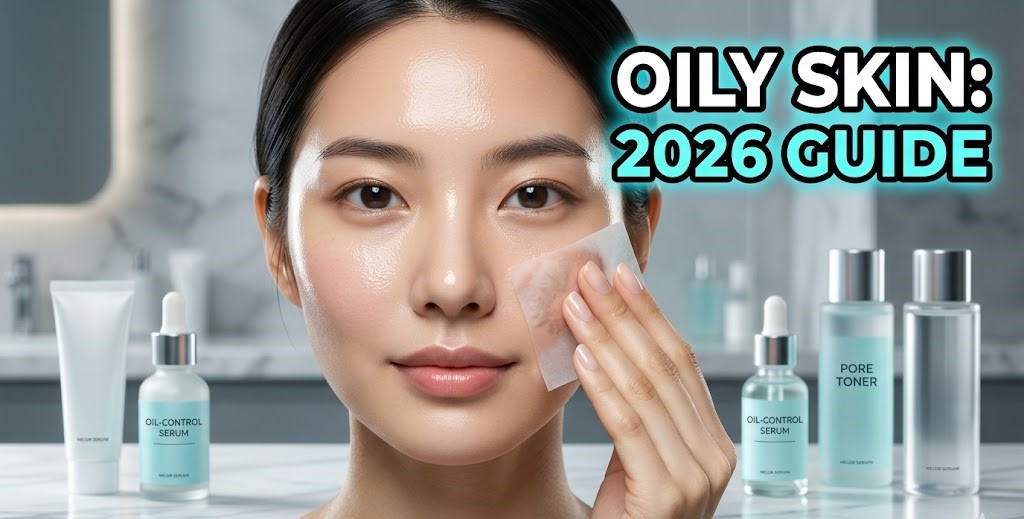
Let’s be honest: looking like a glazed donut is only a “vibe” when you’re a pastry. If your face feels like an oil slick by noon, it’s easy to feel frustrated. However, in 2026, we’ve moved past the era of harsh astringents and “squeaky clean” skin. Oily skin is actually quite resilient—it tends to have fewer visible fine lines and wrinkles because those natural oils keep things lubricated. The goal isn’t to strip your skin of its soul; it’s to find balance.
According to the American Academy of Dermatology (AAD), oily skin is characterized by an excess of sebum. To manage it, you need a daily regimen that supports your skin’s protective barrier while keeping shine in check.
The Science: The Balance Equation
In dermatological terms, we look for an equilibrium between hydration and sebum production. We can model a “Healthy Skin State” ($H$) using the relationship between ceramide concentration ($C$) and sebum levels ($S$):
$$H = \int_{morning}^{night} (C – S) dt$$
When $C > S$ and the barrier is intact, the skin appears matte yet hydrated. When $S$ overwhelms the barrier, we see the characteristic shine and potential for comedonal acne.
The 4-Step Strategy for Oily Skin
1. Cleanse (The Foundation)
Cleansing is non-negotiable. You need a gentle, foaming gel cleanser that removes dirt and excess oil without triggering a “rebound” effect. If you strip your skin too harshly, it actually panics and produces more oil to compensate.
Frequency: Twice daily (AM/PM) and after sweating.
Pro-Tip: Follow up with an alcohol-free toner to remove any lingering residue.
2. Target Concerns
This is where the heavy lifting happens. For oily skin, lightweight serums are your best friend.
Retinol: Helps resurface the skin and minimize the appearance of pores.
Salicylic Acid: Great for “degunking” pores if you’re prone to blackheads.
Skipping moisturizer because you’re oily is like skipping water because it’s raining. Dehydrated skin creates a weakened barrier. Look for non-comedogenic (won’t clog pores) and oil-free formulas. Lightweight lotions or “water-gels” provide the hydration you need without the weight.
4. Protect (The Shield)
Sun exposure can actually dry out your skin, leading to increased sebum production. The FDA Sunscreen Guidelines recommend at least SPF 30 daily. In 2026, mineral sunscreens have become incredibly sophisticated—providing protection without the greasy “white cast” or heavy feel.
Ingredient Superstar Table
Ingredient
Benefit for Oily Skin
Hyaluronic Acid
Attracts hydration without adding oil.
Ceramides
Restores the “bricks and mortar” of the skin barrier.
Niacinamide
Regulates sebum and reduces redness.
Retinol
Refines skin texture and boosts radiance.
The “No-Go” List for 2026
What to Avoid:
Heavy Oil-Based Creams: Steer clear of cocoa butter or lanolin, which can be highly comedogenic.
Alcohol-Based Astringents: These provide a temporary “tight” feeling but ultimately sabotage your barrier.
Managing oily skin is about working with your biology, not against it. By prioritizing ingredients like ceramides and niacinamide, and never skipping your daily SPF, you can transition from “greasy” to “glowing.” Consistency is the true “secret” ingredient. Once you establish a routine that respects your skin barrier, the oil becomes an asset that keeps your skin looking youthful and resilient for years to come.