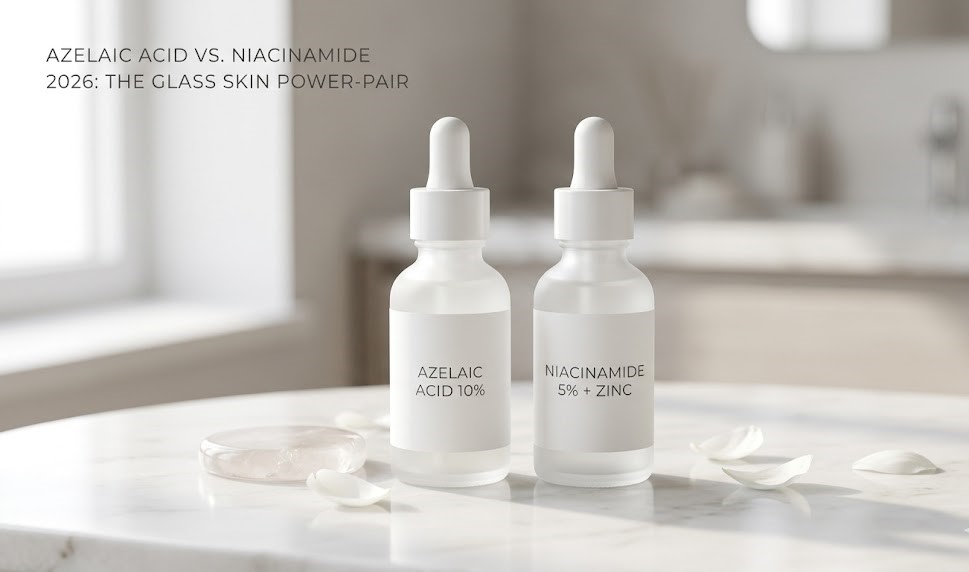

Navigating the “active” ingredient aisles in 2026 can feel like trying to solve a Rubik’s Cube while blindfolded—confusing and potentially messy. But when it comes to the ultimate showdown for glowy, blemish-free skin, the real winner isn’t a single star, but the unexpected synergy between these two heavy hitters. Whether you’re battling persistent redness or just trying to keep your T-zone from becoming a mirror, understanding this duo is your ticket to a resilient complexion.
The Core Concept: Skin Resilience in 2026
In a world where we’re constantly exposed to environmental stressors, skin barrier support has become the baseline for all effective routines. While many reach for aggressive exfoliants, the modern approach favors ingredients that multitask without the “purge.” Azelaic Acid, a dicarboxylic acid found in grains, is the “specialist” that targets acne-causing bacteria and inflammatory redness (rosacea).
On the flip side, Niacinamide (Vitamin B3) acts as the “general manager” of your face. It regulates oil production, minimizes the appearance of pores, and bolsters ceramide production. Instead of choosing between the two, 2026 skincare science suggests that layering them can address hyperpigmentation and congestion through multiple biological pathways simultaneously.
The Dual-Action Routine: How to Layer Like a Pro
To maximize results without triggering “tingle-overload,” you need a disciplined application strategy. Consistency beats intensity every single time.
- Step 1: The Gentle Prep. Use a low-pH cleanser to prepare the canvas. Avoid hot water, which can induce inflammation and make pores look larger.
- Step 2: The Balancer (Niacinamide). Apply your Niacinamide serum first. Because it is typically water-based and incredibly gentle, it preps the barrier and calms the skin before the more active acid follows.
- Step 3: The Corrector (Azelaic Acid). Apply a pea-sized amount of Azelaic Acid (10-15%). This targets the “trouble zones”—areas with PIH (post-inflammatory hyperpigmentation), active breakouts, or chronic redness.
- Step 4: The Seal. Finish with a barrier-repairing moisturizer and, if it’s morning, a broad-spectrum SPF 30+.
The “Superstar” Ingredient Breakdown
| Feature/Ingredient | Primary Benefit | Source/Authority |
| Azelaic Acid | Kills acne bacteria & corrects Melasma | Clinikally Blog |
| Niacinamide | Sebum control & barrier fortification | Harvard Health |
| Ceramides | Moisture retention & structural support | Mayo Clinic |
The Radiance Efficiency Formula
To visualize how these ingredients work together, we can define the Radiance Factor ($R_f$) as a balance of Corrective Power ($C$) and Barrier Strength ($S$) against the level of Inflammation ($I$):
$$R_f = \frac{C \times S}{I + 1}$$
By using Azelaic Acid to boost $C$ and Niacinamide to increase $S$ while simultaneously lowering $I$, you achieve a significantly higher $R_f$, leading to that sought-after “lit-from-within” glow.
Conclusion
At the end of the day, your skin isn’t a battlefield—it’s an ecosystem. While Azelaic Acid and Niacinamide are often pitted against each other in “ultimate face-offs,” they are actually best friends. Niacinamide calms the “fire” that more active treatments can sometimes spark, while Azelaic Acid handles the deep-seated pigment and bacterial issues that a simple vitamin can’t fix alone. If you’re looking for a reset in 2026, stop searching for a single miracle and start building a supportive team.
Also Read : Pore-Less Living: The 2026 Master Guide to Resurfacing Your Skin