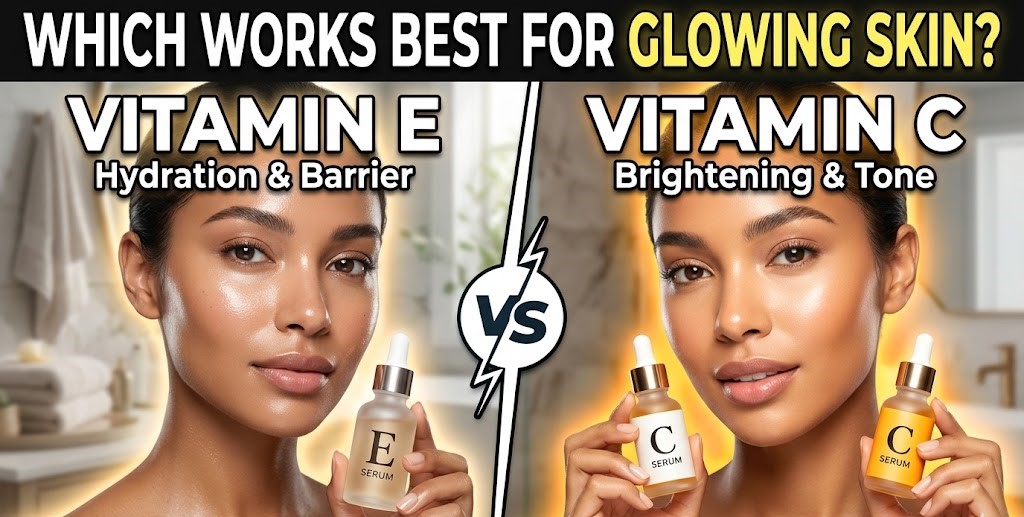

Achieving a radiant glow is about more than just surface-level care; it requires protecting your skin from daily environmental stressors like pollution, UV rays, and blue light. These factors create free radicals—unstable molecules that lead to dullness and premature aging. To combat this, two powerhouses dominate the skincare world: Vitamin C and Vitamin E.

The Power of Vitamin C: The Brightener
Vitamin C is a water-soluble antioxidant essential for skin clarity and radiance.
- Primary Action: Neutralizes free radicals and inhibits excess melanin production by interacting with copper ions at tyrosinase-active sites.
- Key Benefits: * Visibly brightens dull skin and enhances natural radiance.
- Reduces dark spots and hyperpigmentation.
- Stimulates collagen biosynthesis for firmer, more youthful-looking skin.
- Best For: Individuals with uneven skin tone, oily/combination skin, or early signs of aging.
The Power of Vitamin E: The Protector
Vitamin E is a fat-soluble antioxidant that lives naturally in your skin’s lipid barrier.
- Primary Action: Protects skin lipids from oxidative damage and strengthens the natural barrier.
- Key Benefits:
- Deeply nourishes and improves skin softness.
- Reduces moisture loss (Transepidermal Water Loss).
- Calms irritation and inflammation, supporting the skin’s healing recovery.
- Best For: Dry, dehydrated, or sensitive skin types, and those with a compromised skin barrier.
Vitamin C vs Vitamin E: At a Glance
| Feature | Vitamin C | Vitamin E |
| Solubility | Water-soluble | Fat-soluble |
| Primary Goal | Brightening & Collagen | Barrier Repair & Hydration |
| Best For | Dullness & Pigmentation | Dryness & Sensitivity |
| Texture | Lightweight Serums | Rich Oils or Creams |
| Usage | Primarily Morning (AM) | Morning or Night (AM/PM) |

The Ultimate Synergy: Why Use Both?
Science shows that Vitamin C and Vitamin E are better together. Vitamin C serves as the primary replenisher of Vitamin E; after Vitamin E neutralizes a free radical and becomes oxidized, Vitamin C “recharges” it back to its active form.
Dermatologist Insight: This synergy provides a double-layered defense, protecting both the aqueous (water) and lipid (oil) compartments of the skin cells against UV and pollution damage.
Explore More on Antioxidant Science
- Vitamin C in Dermatology (NIH): A deep dive into the mechanisms of action and clinical applications of topical Vitamin C.
- Synergy of Vitamins C & E (ResearchGate): Peer-reviewed research on why these two vitamins are more effective when combined.
- The Linus Pauling Institute: Vitamin C & Skin Health: Comprehensive academic resource on collagen synthesis and photodamage.
- Vitamin E in Dermatological Practice (PMC): A review of the historical perspective and clinical implications of Vitamin E.
- Journal of Clinical and Aesthetic Dermatology: Case studies on antioxidant treatments for hyperpigmented and photodamaged skin.
Also Read : Adult Acne: What Causes It and What To Do About It