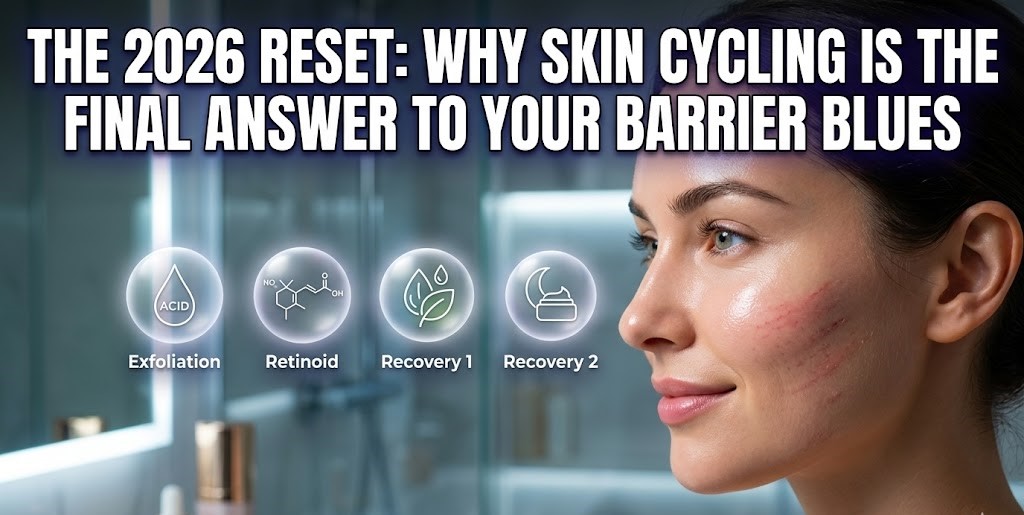

We’ve all been there—buying that 12-step routine we saw on a viral stream only to end up with a face that feels more like a raw sunburn than “glass skin.” In the post-pandemic era, we got a little too obsessed with “ingredient cocktails,” and our skin barriers paid the price. Skin cycling isn’t just a trend; it’s a strategic retreat that allows your skin to actually work with the products you’re buying, rather than fighting them for survival.
The Strategic Retreat: What is Skin Cycling?
At its core, skin cycling is a four-night schedule that prioritizes “rest days” for your face. Instead of bombarding your epidermis with acids and retinoids every single morning and night, you rotate them to prevent the chronic inflammation that often leads to premature aging and sensitivity.
While the term was popularized by Dr. Whitney Bowe, the medical foundation is something dermatologists have practiced for decades: the “slow start.” By giving your skin 48 hours of pure recovery, you’re allowing the skin barrier to repair its lipid layers, which protects you from infection and environmental pollutants.
The 4-Night Protocol: A Step-by-Step Breakdown
To execute a successful cycle, you only need three core components: a chemical exfoliant, a retinoid, and a high-quality moisturizer.
- Night 1: Exfoliation. Cleanse and apply a chemical exfoliant (like Glycolic or Salicylic acid). This clears away dead skin cells so the next night’s products can penetrate deeper.
- Night 2: Retinoids. This is your “power” night. Retinoids trigger collagen production and cell turnover. To minimize irritation, apply moisturizer first around the eyes and nose as a “buffer.”
- Nights 3 & 4: Recovery. The most important part. No “actives” allowed. Focus entirely on hydration and barrier repair. This is where you use your heavy creams and hydrating serums.
- Repeat. After Night 4, you head back to Night 1.
The “Actives” vs. Recovery Breakdown
| Night | Focus | Primary Benefit | Authority Source |
| 1 | Exfoliation | Increases product penetration | AAD Exfoliation Guide |
| 2 | Retinoids | Reduces fine lines & acne | Cleveland Clinic Retinol Info |
| 3 & 4 | Recovery | Repairs the acid mantle | Derm-Approved Barrier Science |
The Skin Health Efficiency Formula
To maximize results without triggering “distress,” your routine should follow the balance of cellular turnover (T) and barrier resilience (B) against the irritation potential (I) of your products.
Shealth=I(T×B)+Rest Days
In 2026, we’ve learned that increasing “Rest Days” in the numerator is the most effective way to lower the overall inflammatory load without losing the benefits of the active ingredients.
Conclusion
Skin cycling is essentially a “less is more” approach that actually makes sense. If you’ve been struggling with blotchiness or that tight, “shiny but dry” feeling, your skin is likely crying out for a recovery night. It’s better to use a powerful retinoid twice a week consistently than to use it every day for a week, burn your face, and then stop using it for a month. Consistency, not intensity, is the goal for 2026.
Also Read : The 2026 Guide to a Natural Skincare Routine: Science, Steps, and Sourcing